A new report by Innovation Observatory, more than $378 billion will be collectively invested in building electricity smart grids by 2030. Sources: Http://Xrl.Us/Bii2sf http://xrl.us/bigqfh

Thursday, May 04, 2006

Google, GS, SENSUS,TXU, GE, EarthLink put $230M in Current Communications ~ 10 Mbps Symmetrical speed Broadband over Power Lines Internet service !!!


CURRENT Communications Announces $130 Million in Investments in Broadband over Power Line Networks


GERMANTOWN, Md.--(BUSINESS WIRE)--May 4, 2006--
TXU, GE, EarthLink and Sensus Join CURRENT to Improve Electric Grid Efficiency, Reliability and Security, Offer Consumer Broadband Service Alternative


CURRENT Communications Group, LLC, the leader in broadband over power line (BPL) networks, announced today $130 million in equity investments from new and existing investors to accelerate the deployment of BPL-enabled "Smart Grid" electric utility networks and alternative broadband communication services.

New strategic equity investors are TXU Corp. (NYSE: TXU), for which CURRENT will provide Smart Grid capability over the majority of TXU Electric Delivery's lines, representing more than two million customers in Texas; General Electric Co. (NYSE:GE); EarthLink, Inc. (NASDAQ: ELNK), which will serve as a retail provider of CURRENT's broadband services; and Sensus Metering Systems (Bermuda 1) Ltd., a leader in water, gas and electric utility metering and automatic meter-reading solutions. Existing equity investors include Duke Energy Corporation (NYSE: DUK); EnerTech Capital Partners; Goldman, Sachs & Co.; Google Inc. (NASDAQ: GOOG); Hearst Corporation; and Liberty Associated Partners, LP, an investment partnership between Liberty Media Corporation (NYSE: L) and the Berkman family.

CURRENT uses BPL technology to create a multipurpose high-speed data network by placing advanced digital equipment on electric distribution networks. For the first time, an electric utility can monitor and control - in real time - the millions of components in the electric distribution network, improving its reliability, efficiency and security. The same technology can be used to manage gas and water distribution networks, as well as to enable consumers to monitor and control their own electricity usage.

"This technology provides utilities with a more intelligent, real-time and secure power grid that should help conserve energy, reduce electricity disruptions and protect critical infrastructure," said Alex Urquhart, president and CEO of GE Energy Financial Services. "Through our Energy Financial Services and Global Media & Communications businesses, GE's investment in CURRENT furthers our mission to grow by supporting innovative energy delivery technology."

Approximately $270 billion is spent annually in the United States for electricity, with demand expected to grow 40 percent by 2020. A Smart Grid can reduce energy demand and the need for more power plants, while improving reliability. The Electric Power Research Institute projects that Smart Grid-enabled distribution could reduce electrical energy consumption by 5 to 10 percent, carbon dioxide emissions by 13 to 25 percent, and the costs of power-related disturbances to business by 87 percent.

In Texas, CURRENT is deploying the first BPL-enabled Smart Grid with TXU Electric Delivery, a subsidiary of TXU Corp., which will create the nation's most advanced electric distribution infrastructure serving more than two million homes and businesses including the Dallas-Forth Worth area. A range of "smart" equipment and applications - automated meters, 24/7 power quality monitoring and remote security cameras - will be installed on the electric distribution network to provide TXU Electric Delivery with real-time information about power consumption, availability and quality, while enhancing security monitoring.

In addition to enabling a Smart Grid, the same communications network will deliver superior consumer broadband service, including a range of services such as interactive gaming and emerging multimedia applications. High-performance Internet, voice, and video service will be available to residential and business subscribers simply by plugging into an ordinary electric outlet.

"With high-speed support for both uploads and downloads and ease of deployment, CURRENT BPL gives us another viable alternative to the broadband services we now provide," said Garry Betty, EarthLink, president and CEO. "As a leading Internet provider, EarthLink is working with companies like CURRENT to deliver next-generation broadband service needed by today's home and business users to better access videos, large batches of pictures and other online content."

"Our deepening partnership with a range of companies, including our investors, demonstrates just how vital our utility and communication solutions are becoming in fueling the growth of the digital economy," said William H. Berkman, chairman and co-founder of CURRENT. "These investments recognize that the future lies in providing a choice to consumers in their use of both electricity and communications. CURRENT helps utilities respond to the calls of federal and state regulators to upgrade their infrastructure, while giving businesses and consumers control over their electricity usage and access to the next generation of communications services and content."

READ MORE: CNET News.com

Click and Read: EarthLink to offer internet to 6,000 DUKE ENERGY and Ambient Corp. Broadband over Power Line`s customers !!!

Wednesday, May 03, 2006

Telkonet/MST Introduces Telkonet Energy Services - New Division Offers Energy Management Through its Telkonet iWire System(TM


Wednesday May 3, 10:20 am ET
First Easily Deployed Complete System for Building-Wide Energy Management and Control

GERMANTOWN, Md.--(BUSINESS WIRE)--May 3, 2006--Telkonet, Inc. (Amex:TKO - News), the leader in providing in-building broadband access over existing electrical wiring, today announced the formation of Telkonet Energy Services (TES), a new division that will focus on providing energy data, energy management and energy market participation to residential and commercial properties nationwide. The installation of the proven Telkonet iWire System "energizes" the electrical infrastructure of residential and commercial buildings, creating a fully responsive data network. This network is then used to acquire energy information and control components of the HVAC system within the building, such as boilers, air conditioners, fans, pumps and thermostats.


The Company is currently negotiating to provide these services to several high-profile building owners in New York City, Chicago and Miami.

This division will operate within Telkonet's subsidiary, Microwave Satellite Technologies, Inc. (MST) of Hawthorne, New Jersey and will use a combination of advanced data technologies to acquire and display energy use and pricing information.

"With a simple installation, building owners and managers can now monitor, control and adjust energy usage and needs throughout a building using the same Telkonet iWire System that is currently being used to deliver high-speed Internet and VoIP services in MDU's and hotels throughout the country. Telkonet Energy Services takes advantage of the inherent benefits of the existing Telkonet product line in providing the perfect solution to the increasingly important need to manage and control energy usage. Building owners, managers and residents will be able to access energy information from any electrical outlet, or even from a remote location," said Frank Matarazzo, President of MST.

The TES includes installation of equipment that can facilitate participation in Demand Response programs. Also included in TES are systems to comprehensively combine information from photovoltaic (solar power) systems, sub-metering systems that monitor electrical use in individual apartments, existing energy management systems, and emergency generators.

Real-Time Energy Monitoring System

The Telkonet iWire System also creates a local area network within the building that can be accessed remotely via web portals by building owners and managers to monitor energy use in real time, allowing them to control usage in either specific areas of buildings, throughout the building, or even groups of buildings. Wireless thermostats connected to the Telkonet system can also be used to remotely control space temperature set-points to reduce energy consumption or improve comfort conditions.

TES offers the first easily-deployed system to display real time energy use, pricing information, and the means by which to optimize energy market participation. TES provides a user friendly web-based interface where energy use will be displayed according to the owners' and users' preferences -- the first system offering the ability to mix, match, calculate, and compare any combination of the many available data sources delivered through the Telkonet iWire System infrastructure.


The new 200 Mbps BROADBAND over POWER LINES Technology

Ambient Corporation Announces Availability of X2: 200 Mbps Next-Generation Broadband over Power Lines Access Device


Ambient Announces Availability of X2
Next-Generation BPL Access Device Provides Industry-Leading Performance and Features
Wednesday May 3, 8:30 am ET

CHARLOTTE, N.C.--(BUSINESS WIRE)--May 3, 2006--Ambient Corporation (OTCBB: ABTG - News), a leader in Broadband over Power Lines (BPL) solutions, unveiled today its next-generation BPL access device, known as X2. This follow-on product line to Ambient's X-Node, which has been successfully deployed in multiple locations throughout the United States, provides unparalleled capabilities to the BPL market.


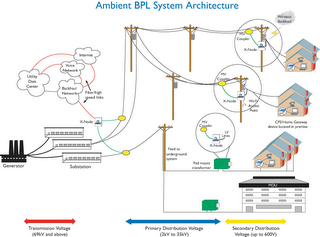
Ambient's X2 product line integrates 200-Mbit Generation 2 technology from DS2 in a unique, proprietary design which provides up to three BPL interfaces to supply unprecedented levels of BPL bandwidth, combined with optional gigabit Ethernet, direct fiber connections, and 802.11a/b/g wireless capabilities.

X2 nodes are available with an optional backup battery and integrated low-voltage capacitive coupler. The X2 includes an integrated NEMA-4 enclosure, providing both indoor and weather-resistant outdoor capabilities in a reduced form factor. X2 nodes can be installed in pad-mount, pole-top, and wall-mount locations.

Additional advanced sensor and utility applications will be available for X2.

John Joyce, CEO of Ambient Corporation, stated, "Ambient once again demonstrates its leadership in the BPL industry by providing the most capable Generation 2 equipment. Our new X2 supplies utilities and BPL service providers with all of the features they need to successfully and competitively deploy next-generation BPL networks with extended capabilities."

Ambient's X2 is fully supported by the Company's Network Management System, which is presently in trials at customer locations.

"Ambient continues to demonstrate their market leadership in the Americas by proving the effectiveness of our latest chipsets in their products. We at DS2 are pleased to have a strategic partner in Ambient who continues to demonstrate their belief and commitment to aggressively pursue the new PLC/BPL applications of our market-leading latest technology. The value Ambient adds to each of their products will be a key factor in the success of their X2 product," stated Jorge Blasco, CEO of DS2.

Ambient will commence shipments of X2 in the second quarter of 2006.


The new 200 Mbps BROADBAND over POWER LINES Technology

Tuesday, May 02, 2006

Click-> E-mail Out of Every Plug

Broadband sent over power lines offers Internet access everywhere in your house—and could also offer the country a way to save energy
by James Fallows

The Atlantic Monthly | June 2006


The new 200 Mbps BROADBAND over POWER LINES Technology

Verizon Earns Fall on Fiber-Optics Project

Verizon 1Q Earnings Decline 7.1 Percent By PETER SVENSSON, AP Technology Writer
Tue May 2, 6:12 PM ET

NEW YORK - Verizon Communications Inc., racing to connect homes with fiber-optic lines to offset a decline in its traditional phone business, Tuesday reported a 7.1 percent drop in first-quarter earnings due to special items.


Verizon, the country's largest telecommunications company by revenue, earned $1.632 billion, or 56 cents a share, compared with $1.757 billion, or 63 cents a share, in the same quarter last year.

The New York-based company had revenue of $22.7 billion, up 25 percent from $18.2 billion in last year's first quarter due to the acquisition of MCI Inc., which closed in January this year.

Excluding special items, earnings were 60 cents a share, topping by a penny the average estimate of analysts surveyed by Thomson Financial. Net income including special items was down just 0.2 percent from last year, despite a higher income tax provision.

Among the special items was the cost of rebranding MCI services, a change in accounting to expense option-like grants to Verizon Wireless employees, and the continued movement of New Jersey employees to AT&T's old headquarters in Basking Ridge.

Shares of Verizon fell 15 cents to close at $32.64 in afternoon trading on the New York Stock Exchange. After declining through most of last year, the stock is up 10 percent so far this year.

Verizon is the only major U.S. telecommunications company to bet on connecting homes directly with fiber optics — the others are focusing on sending broadband over phone lines using digital subscriber line technology, or DSL.

"Our investment dollars are focused on this initiative," Doreen Toben, the company's chief financial officer, said on a conference call.

Investors have been leery of the project, as shown by Verizon's stock decline last year.

"We see little change in investor sentiment regarding this deployment of capital over the next several quarters, even though we believe it will provide long-term benefits to the company," Stifel Nicolaus analyst Christopher King wrote in a research report.

The cost of the 15-state FiOS buildout reduced first-quarter earnings by 6 cents a share, excluding capital expenditures.

Verizon said it's ahead of schedule in making FiOS available — 3.6 million homes are eligible to be connected — but connection costs are running higher than the target of $717 per home, Toben said.

In areas where FiOS has been available for a year, 17 percent of homes have signed up for broadband, the company said. It has also started competing with cable companies by selling video over FiOS in areas where it has been able to secure local video franchises. It didn't provide the number of video subscribers it has, but said adoption rates were promising.

In another positive sign, Verizon said that for the second quarter in a row, it added more broadband subscribers, including DSL, than it lost phone lines.

In the wireline segment as whole, revenue grew 33 percent to $12.5 billion due to the addition of MCI's business, the bulk of which served large corporate customers. Toben said Verizon has no intention of retaining MCI long-distance customers outside its local-phone service area.

Verizon said the integration of MCI was going according to plan, and had resulted in more than 1,200 job cuts. It said results should improve through the year, as it cuts more costs by moving traffic from MCI's to its own network.

Verizon Wireless added 1.7 million customers in the quarter for a total of 53 million, just behind Cingular Wireless LLC with 55.8 million.

Verizon Wireless is a joint venture with Vodafone Group PLC, which Verizon wants to buy out. Britain-based Vodafone has so far demurred.

Revenue at Verizon Wireless was $8.8 billion, up 19 percent from a year ago.

Verizon's largest competitor, AT&T Inc., has announced a $67 billion deal to take over BellSouth Corp., which would make AT&T far larger than Verizon.

Verizon chief executive Ivan Seidenberg said the deal would give AT&T the opportunity to cut costs, but said Verizon was well positioned to compete in growth areas like wireless and data.

"I think we have significant opportunity on the growth side. On the cost side, we'll just have to make the critical mass we have — which is pretty significant — work better," he said.


The new 200 Mbps BROADBAND over POWER LINES Technology

Monday, May 01, 2006

Watch Current Communication`s Symmetrical BROADBAND over POWER LINES video ads -- approx. 4 minutes

Current Readies Voice over BPL

Once a communications curiosity, broadband over power lines will take a deeper bite out of cable and DSL.
January 3, 2006

....

"Mr. Birnbaum said that with the next generation of its(CURRENT BPL) technology, the company will get up to 20 Mbps [megabits per second] symmetrical speeds. Current will market between 3 Mbps and 5 Mbps of that, he said. "

more:
http://www.redherring.com

Friday, April 28, 2006

San Diego Gas & Electric is conducting the only Broadband over Power Line (BPL) trial in the state of CALIFORNIA.!!!


``The commission's actions create a very favorable climate for the development of BPL in California,'' said SDG&E spokesman Eddie Van Herik.
~~~~~


fyi: AMBIENT ENTERS CALIFORNIA MARKET
SDG&E Selects Ambient to Assess BPL Technology

Boston, MA, July 21, 2005

======

Regulators ease the way for broadband over power lines
By Jessie Seyfer
Mercury News
Posted on Fri, Apr. 28, 2006

Three main wires feed into most California homes -- cable, phone and electricity.

While cable and phone lines have brought the Internet to residents for years, on Thursday state regulators cleared a path for electrical lines to do the same one day.

Broadband over power lines, or BPL, is a fledgling technology that sends data over wires without interfering with electricity flows. But BPL presents a regulatory dilemma as it's both an electrical and a communications service. With its legal status unclear, companies have been slow to develop BPL services.

So to spur BPL on, the California Public Utilities Commission voted Thursday to reduce the number of regulatory hurdles companies must clear to experiment with the technology.

``BPL can provide Californians with a new broadband pipe to the home,'' said Commissioner Rachelle Chong, who wrote the new guidelines, which were adopted by a 4-1 vote. ``More broadband competition will bring benefits to Californians. Thus, this . . . decision is pro-consumer in the most fundamental ways. It will introduce a new competitor, which in turns helps drive broadband prices down.''

The dissenter was Commissioner Geoffrey Brown, who favored more stringent regulations.

Utility companies are the gatekeepers for any experiments that BPL companies conduct on their lines. Companies that run tests do not necessarily have to be utilities. A broadband provider -- such as the Google-backed Current Communications Group, of Maryland -- could test a BPL service.

The rules adopted Thursday require less PUC oversight for agreements that BPL companies strike with utilities to access their power lines.

If a utility company decides to conduct its own BPL trials, the guidelines call for such experiments not to be funded with money collected from utility rate-payers.

The rules acknowledge that BPL is in such an early stage of development that it wouldn't be fair for ratepayers to fund something so unproven.

`Favorable climate'

Utility companies praised the decision.

``We think it does a good job of helping encourage utility participation in BPL,'' said John Nelson, a spokesman for PG&E, which is not currently conducting any trials but is interested in the technology.

San Diego Gas & Electric is conducting the only BPL trial in the state.

``The commission's actions create a very favorable climate for the development of BPL in California,'' said SDG&E spokesman Eddie Van Herik.

Cable and phone companies could suffer if a technology like BPL succeeds, but AT&T spokesman John Britton said his company felt it was serving customers well.

``AT&T shares the commission's goal of expanding broadband access and consumer choice,'' he said. ``Customers tell us they're very satisfied with AT&T-Yahoo Internet service.''

Comcast spokesman Andrew Johnson said, ``Obviously this is a very crowded field with lots of competitors. This would just be one more competitor.''

Yet for all its promise, BPL presents some major technological problems.

For one thing, it's slow. Present technology allows it to run about as fast as DSL at its slowest, said Juan Fernandez, an analyst with Gartner. High-end DSL and cable services are five to eight times faster.

As part of the commission's ruling, a BPL company would be responsible for costs associated with adding equipment to poles.

BPL Internet signals take the form of radio pulses that piggyback on the electrical wires. The radio pulses leak off the power lines and interfere with nearby radio signals.

Rural areas

It's also unlikely that BPL will end up being the solution to providing broadband to communities where there's no DSL or cable-modem service. That's because it's not as simple as plugging a computer into the socket, Fernandez said. To get BPL out to rural areas, a significant amount of equipment needs to be installed on the lines.

``You need some subscriber density to make it cost-effective,'' he said. ``It's not really the kind of thing for farms.''

from:
http://www.siliconvalley.com

LOS ANGELES TIMES: PUC Approves Power Lines for Net Access


By James S. Granelli, Times Staff Writer
April 28, 2006

Despite protests from consumer advocates, state regulators on Thursday approved a plan allowing power utilities to offer high-speed Internet connections over electricity lines.

In a 4-1 vote, the Public Utilities Commission granted utilities the authority to establish subsidiary companies for delivering broadband over power line, or BPL, and the option of transferring free the use of the power grid to those affiliates.

"We do this because of our hope that BPL will bring valuable, additional competition to the California broadband market," said Commissioner Rachelle Chong, who sponsored the proposal.

"As the home of Silicon Valley, we want to be a broadband leader in the nation."

The technology, working in some small areas of the country but not yet in any mass market, has been "on the horizon of widespread U.S. adoption for some time," said Jorge Blasco, chief executive of Design of Systems on Silicon, a Spanish company that makes the gear that supports power-line broadband. The PUC's vote "could be a catalyst for delivering high-speed, cost-effective access to consumers."

But Commissioner Geoffrey F. Brown, whose alternative plan was shot down, argued that Chong's proposal would be "giving away an asset in perpetuity." Brown said that because the lines were built with ratepayer money, electricity customers should share in the benefits.

Chong's proposal gives utilities the option of turning over use of the lines free or charging access fees, profit from which would be split with ratepayers.

Only San Diego Gas & Electric Co., a unit of Sempra Energy, has said it would give free access to a subsidiary. Southern California Edison Co. and Pacific Gas & Electric Co. have said they would prefer a business model in which they charge a provider of broadband over power line for using the lines.

Consumer advocates chafed over Chong's views.

"This commission took the laudable objective of encouraging more high-speed Internet competitors and undermined it with a ham-handed, ideology-blinded giveaway to Sempra Energy," said Michael Shames, executive director of the Utility Consumers' Action Network.

Bill Nusbaum, senior attorney for the Utility Reform Network, said the agency had a "warped" perspective if it believed it created a situation that allowed utilities to enter a risky business while protecting utility customers from any downside.

Commissioners are "busy patting themselves on the back for being such 'enlightened' regulators when all they have done is to continue what this commission is so good at — corporate giveaways," he said.

A San Diego Gas & Electric spokesman said the commission's actions "create a very favorable climate for the development of BPL systems." The company will continue testing new gear "to determine its safety and reliability on our system."

Edison, a unit of Edison International, said the new rules would give it the framework for discussions with power-line broadband providers. And Pacific Gas & Electric, a unit of PG&E Corp., said the decision would spur broadband services by "removing unnecessary regulatory obstacles and uncertainty."

Both had opposed an earlier version of Chong's proposal that would have prohibited utilities from charging for access to the power grid.


=====
The new 200 Mbps BROADBAND over POWER LINES Technology